Cash Application Automation Software: AR Efficiency Guide
Achieve 90 straight through processing with AI cash application software It automates payment matching and enables faster exception handling
Cash Application Automation Software uses artificial intelligence, machine learning, and intelligent matching algorithms to automatically apply incoming customer payments to open invoices. The result is faster cash posting, improved accuracy, reduced manual effort, enhanced visibility into accounts receivable, and accelerated financial close cycles.
Quick Answer
Cash Application automation software is a technology solution that automatically matches customer payments with outstanding invoices using data extraction, and reconciliation workflows. It improves processing speed, reduces unapplied cash, minimizes manual intervention, and helps finance teams achieve higher operational efficiency.
Key Takeaways
- Automates payment-to-invoice matching across multiple payment channels.
- Reduces manual cash posting and reconciliation workloads.
- Improves straight-through processing rates and posting accuracy.
- Accelerates accounts receivable operations and cash visibility.
- Enhances exception management through AI-assisted workflows.
- Supports faster financial reporting and cash forecasting.
- Minimizes unapplied cash and payment processing delays.
What It Is Cash Application Automation Software
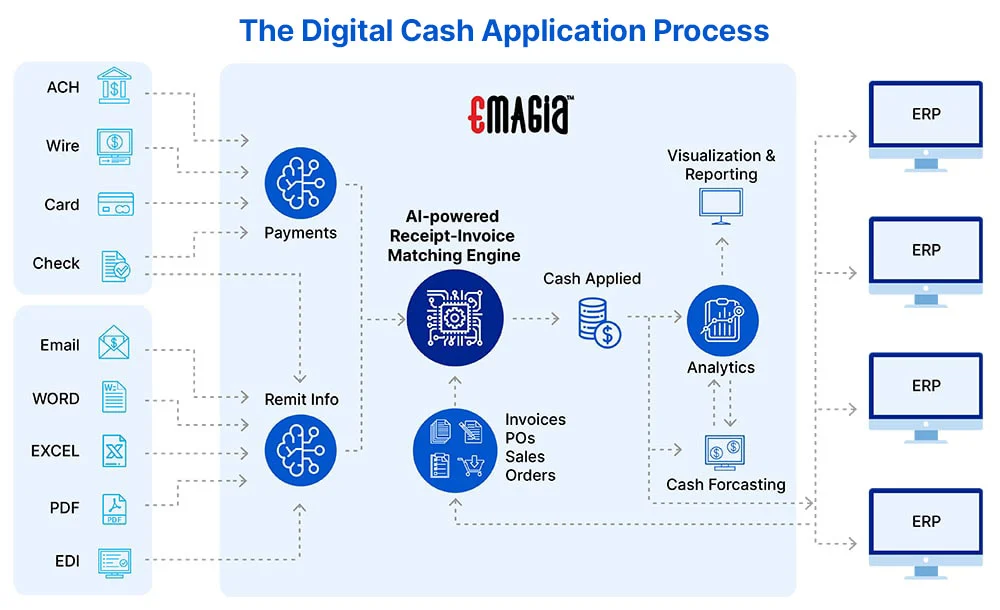
Cash Application automation software is an intelligent financial technology solution that streamlines the process of applying customer payments to open invoices. It gathers payment information from banks, lockboxes, remittance files, emails, portals, and electronic payment systems, then automatically identifies the correct customer accounts and invoices.
Modern platforms use artificial intelligence, machine learning, and predictive analytics to improve matching accuracy and continuously learn from historical payment behavior. This enables organizations to process large payment volumes efficiently while reducing operational costs.
Top Industry Talks About Cash Application Automation Software Chatgpt And Read Also
Why It Matters Cash Application Automation Software
Organizations receive payments through multiple channels, often accompanied by incomplete, inconsistent, or missing remittance information. Manual processing creates delays, increases errors, and limits visibility into cash positions.
Cash Application automation helps finance teams accelerate cash posting, improve customer account accuracy, reduce unapplied cash balances, and support better working capital management. Faster payment reconciliation also contributes to stronger customer relationships and more reliable financial reporting.
How It Works Cash Application Automation Software
The system captures incoming payment and remittance data from multiple sources, standardizes information, identifies customer records, matches payments against invoices, and automatically posts transactions to enterprise financial systems.
Advanced AI models continuously analyze payment patterns, customer behavior, deduction trends, and historical matching outcomes to improve future automation rates.
Purpose of Cash Application
The primary purpose of Cash Application is to ensure that customer payments are accurately and promptly applied to outstanding invoices. This process updates accounts receivable balances, improves cash visibility, supports financial accuracy, and enables organizations to maintain healthy cash flow operations.
Key Components Of Cash Application Automation Software
-
Payment Data Capture – Collects payment information from banks, lockboxes, ACH transactions, wire transfers, checks, and digital payment systems.
-
Remittance Processing – Extracts invoice references and payment details from emails, portals, EDI files, PDFs, and documents.
-
Matching Engine – Automatically associates payments with open invoices using rules, AI models, and customer payment history.
-
Exception Management – Identifies unmatched transactions and routes them for resolution.
-
Workflow Automation – Standardizes approval processes and exception handling activities.
-
ERP Integration – Synchronizes cash posting activities with enterprise accounting and receivable systems.
-
Analytics and Reporting – Provides visibility into processing performance, cash flow, and operational efficiency.
Impact on Business
Organizations implementing Cash Application automation often experience significant improvements in productivity, processing accuracy, and financial visibility. Automated workflows allow finance professionals to focus on strategic analysis rather than repetitive transaction processing.
The technology also improves customer satisfaction by reducing account discrepancies and accelerating issue resolution.
Step-by-Step Workflow
-
Receive Payment Information – Payment data arrives from banks, payment gateways, lockboxes, and financial institutions.
-
Capture Remittance Data – Remittance information is extracted from structured and unstructured sources.
-
Identify Customer Records – The system associates payment details with customer accounts.
-
Match Payments to Invoices – AI algorithms compare payment references against open receivables.
-
Apply Cash Automatically – Matching transactions are posted directly to accounting systems.
-
Handle Exceptions – Unmatched transactions are routed for review and resolution.
-
Generate Reporting – Dashboards provide performance metrics and operational insights.
Key Metrics & KPIs
- Straight-through processing rate.
- Cash application accuracy.
- Average payment posting time.
- Unapplied cash percentage.
- Exception resolution cycle time.
- Days sales outstanding impact.
- Cost per transaction processed.
- Automation rate improvement.
- Customer dispute frequency.
- Payment matching success rate.
Cash Application
Cash Application is a critical accounts receivable function that converts incoming customer payments into accurately recorded financial transactions. It serves as the connection between revenue recognition, customer account management, and cash flow visibility.
Organizations with efficient Cash Application processes gain greater control over working capital and financial performance.
Cash Application Process
The Cash Application Process involves receiving customer payments, collecting remittance details, matching payments to invoices, posting transactions, resolving exceptions, and updating receivable records.
Traditional approaches rely heavily on manual effort, while modern automated systems use AI to accelerate processing and improve accuracy.
Cash Application Automation
Cash Application Automation eliminates repetitive manual tasks through intelligent workflows and machine learning technologies. The system continuously learns from historical transactions, enabling increasingly accurate payment matching and reduced intervention requirements.
This automation supports scalability, allowing organizations to process growing transaction volumes without proportionally increasing staffing requirements.
Cash Application Software
Cash Application Software provides centralized tools for payment processing, remittance capture, invoice matching, reconciliation, exception management, reporting, and ERP integration.
Modern solutions support multiple payment formats and help finance teams maintain operational consistency across global business units.
Cash Management Application
A Cash Management Application extends visibility beyond payment posting by providing insights into liquidity, treasury operations, cash forecasting, and financial planning. When integrated with automated receivables processes, organizations gain a comprehensive view of cash movement across the enterprise.
This broader visibility helps support strategic financial decision-making and risk management initiatives.
Comparison Table
The following comparison highlights key differences between manual and automated cash application approaches.
| Category | Manual Process | Automated Process |
|---|---|---|
| Processing Speed | Slow | Fast |
| Accuracy | Dependent on staff | AI-enhanced consistency |
| Scalability | Limited | Highly scalable |
| Exception Handling | Manual review | Automated prioritization |
| Operational Cost | Higher | Lower |
| Reporting Visibility | Limited | Real-time insights |
| Cash Posting Time | Hours or days | Minutes or seconds |
| Productivity | Resource intensive | Optimized workflows |
Key Benefits
-
Higher Efficiency – Reduces manual processing effort and improves workforce productivity.
-
Faster Cash Posting – Accelerates transaction processing and account updates.
-
Improved Accuracy – Minimizes posting errors and reconciliation issues.
-
Enhanced Cash Visibility – Provides real-time financial insights.
-
Reduced Unapplied Cash – Improves payment allocation success rates.
-
Better Customer Experience – Reduces billing disputes and account discrepancies.
-
Lower Operating Costs – Decreases labor-intensive processing requirements.
Common Challenges
-
Incomplete Remittance Data – Missing references make payment matching difficult.
-
Multiple Payment Channels – Organizations must consolidate data from diverse sources.
-
Customer Payment Variability – Different payment behaviors create matching complexity.
-
Legacy System Limitations – Older systems may restrict automation opportunities.
-
High Exception Volumes – Complex transactions often require additional review.
-
Data Quality Issues – Inconsistent customer information affects matching accuracy.
Use Cases
-
Manufacturing – Processes large volumes of customer payments and deductions.
-
Retail – Manages high-frequency transactions across multiple channels.
-
Healthcare – Reconciles complex payment and reimbursement structures.
-
Distribution – Supports large invoice volumes and customer account management.
-
Technology Companies – Handles subscription and recurring payment models.
-
Global Enterprises – Standardizes receivable operations across regions.
Detailed Example
-
Customer Submits Payment – A customer transfers funds through an electronic payment channel.
-
Remittance Information Arrives – Invoice references are sent through email or EDI.
-
Data Is Captured Automatically – AI extracts payment and invoice information.
-
Matching Logic Executes – The system compares payment details with open receivables.
-
Invoices Are Identified – Appropriate invoices are selected for payment application.
-
Cash Is Posted – Transactions update financial records automatically.
-
Exceptions Are Escalated – Any unmatched transactions are routed for review.
-
Reports Are Updated – Dashboards reflect current cash and receivable status.
Common Mistakes to Avoid
- Relying solely on manual reconciliation processes.
- Ignoring remittance data standardization.
- Failing to monitor automation performance metrics.
- Overlooking exception management workflows.
- Neglecting integration with ERP systems.
- Maintaining poor customer master data quality.
Best Practices
- Implement AI matching capabilities.
- Standardize payment and remittance collection processes.
- Monitor KPIs regularly and optimize workflows.
- Integrate automation with core financial systems.
- Continuously improve exception handling procedures.
- Maintain accurate customer and invoice data.
Key Features Trends In Cash Application Automation Software
-
◦ Artificial intelligence-driven invoice matching with continuous learning capabilities.
-
◦ Real-time payment visibility across banking and receivable platforms.
-
◦ Intelligent document processing for remittance extraction.
-
◦ Predictive analytics supporting cash forecasting initiatives.
-
◦ Cloud-native deployment models enabling scalability.
-
◦ Automated exception prioritization and resolution workflows.
-
◦ Advanced dashboards delivering operational performance insights.
-
◦ Seamless integration with ERP and treasury management systems.
How Emagia Helps Cash Application Automation Software
Emagia helps finance organizations modernize receivables operations by combining automation, artificial intelligence, analytics, and workflow orchestration within a unified platform. The solution supports intelligent payment matching, automated remittance processing, exception management, and real-time performance visibility.
By integrating automation with advanced analytics, organizations can improve cash application efficiency, enhance operational transparency, reduce manual effort, and gain actionable insights that support better financial decision-making. This approach enables finance teams to focus more on strategic initiatives while maintaining accuracy and control across accounts receivable processes.
Frequently Asked Questions
What is Cash Application automation software?
Cash Application automation software is a technology solution that automatically matches incoming customer payments with outstanding invoices. It uses AI, workflow automation, and data processing tools to improve accuracy, reduce manual effort, accelerate cash posting, and enhance accounts receivable efficiency.
How does Cash Application automation improve financial operations?
Automation improves financial operations by reducing payment processing delays, minimizing unapplied cash, increasing posting accuracy, and providing real-time visibility into receivables. These improvements help organizations optimize working capital management and support faster financial reporting cycles.
What is the Cash Application Process?
The Cash Application Process involves receiving payments, collecting remittance information, matching payments to invoices, posting transactions, resolving exceptions, and updating customer accounts. Automated solutions streamline these activities and significantly reduce manual workloads.
Which model is best for Cash Application software?
AI-driven Cash Application software is generally considered the most effective model because it combines machine learning, intelligent matching, workflow automation, and predictive analytics. This approach enables higher automation rates and continuous improvement over time.
Can AI improve payment matching accuracy?
Yes. AI improves payment matching accuracy by analyzing historical transaction patterns, customer payment behavior, invoice references, and remittance data. Machine learning algorithms continuously refine matching decisions, resulting in better automation performance and fewer exceptions.
What industries benefit most from Cash Application automation?
Manufacturing, retail, healthcare, distribution, technology, consumer goods, and global enterprises benefit significantly from Cash Application automation. These industries often manage large transaction volumes and require efficient receivable processing capabilities.
What are the main KPIs for measuring success?
Important KPIs include straight-through processing rates, payment matching accuracy, unapplied cash percentage, exception resolution time, processing cost per transaction, cash posting speed, and overall automation rates. These metrics help evaluate operational effectiveness.
How does a Cash Management Application support business growth?
A Cash Management Application provides visibility into liquidity, cash flow, treasury activities, and forecasting performance. Combined with automated receivable operations, it helps organizations improve financial planning, reduce risk, and make informed business decisions.
Related Resource1: Visit
Related Resource2: Click Here


Comments
Post a Comment