Cash Application Automation for Faster AR & Payment Matching
Cash application automation is the use of intelligent technology, artificial intelligence, machine learning, and rules-based workflows to match incoming customer payments with open invoices automatically. Businesses use cash application automation to reduce manual posting effort, improve payment accuracy, accelerate reconciliation, and strengthen accounts receivable performance across the order-to-cash cycle.

Cash Application provides intelligent receivable matching automation that handles manually intensive financial processes.
Quick Answer
Cash application automation streamlines the process of matching customer payments to invoices using intelligent algorithms, ERP integration, and remittance data extraction. It improves operational efficiency, reduces unapplied cash, shortens reconciliation cycles, and increases visibility into accounts receivable performance.
Key Takeaways
- Cash Application reduces manual invoice matching and payment posting tasks.
- Automation improves accuracy, speed, and financial visibility.
- AI-powered systems help identify payment patterns and exceptions.
- Order-to-Cash Automation enhances working capital management.
- Cash posting automation minimizes unapplied cash and reconciliation delays.
- Modern Cash Application Software integrates with ERP and banking systems.
- Intelligent cash application solutions support scalability and compliance.
What It Is Cash Application Automation
Cash Application Automation is a finance technology process that automatically matches customer payments to corresponding invoices within accounts receivable systems. It uses data from bank files, remittance advice, ERP records, customer references, and payment portals to complete invoice reconciliation with minimal human intervention.
The primary objective of Cash Application is to improve the speed and accuracy of receivables processing while reducing operational costs. Businesses across manufacturing, healthcare, retail, logistics, banking, and B2B services increasingly rely on automation to manage high payment volumes efficiently.
Modern Cash Application Software combines machine learning, robotic process automation, optical character recognition, and predictive analytics to process structured and unstructured payment data automatically.
Why It Matters Cash Application Automation
Manual receivables processing often causes delayed reconciliation, unapplied cash, deduction disputes, and inaccurate reporting. Finance teams may spend hours reviewing remittance files, identifying short payments, and matching invoices manually.
Cash posting automation helps organizations reduce payment processing delays while improving financial accuracy. Faster cash application also supports improved liquidity management and better customer account visibility.
Companies implementing Order-to-Cash Automation often experience stronger cash flow forecasting, improved collections efficiency, and reduced Days Sales Outstanding.
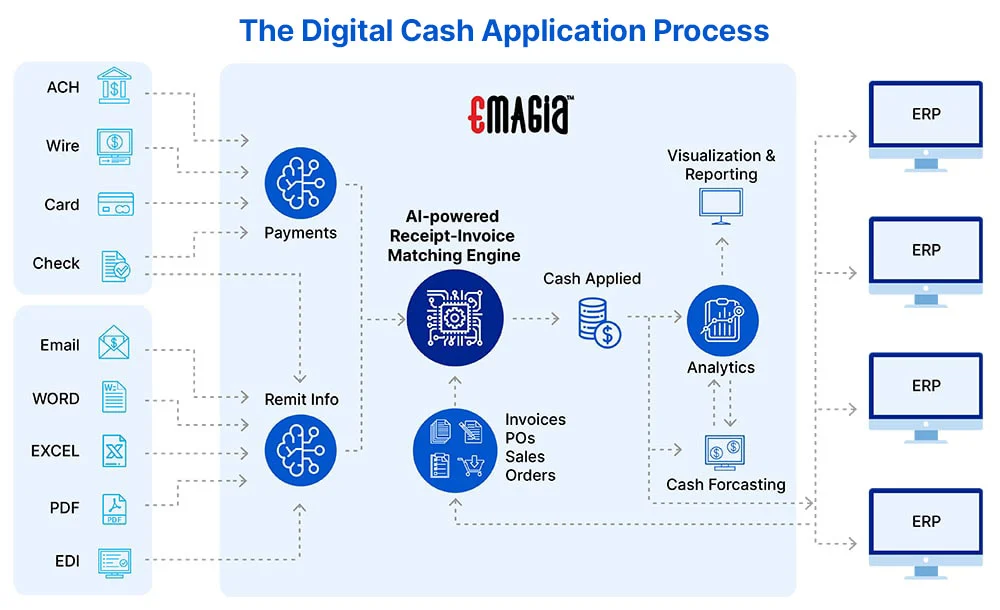
How It Works Cash Application Automation
Cash Application Automation collects payment information from multiple financial channels, including bank lockboxes, ACH transfers, wire payments, checks, payment gateways, and ERP systems.
The system analyzes remittance data using intelligent matching rules and AI-based algorithms. It identifies invoice numbers, customer IDs, purchase orders, deductions, and payment references to reconcile payments automatically.
Once validated, the automation engine posts transactions directly into financial systems and generates exception workflows for unmatched transactions or disputes.
Purpose of Cash Application Process
The purpose of the Cash Application Process is to ensure incoming payments are accurately matched to open receivables. This process supports healthy cash flow, accurate accounting records, and improved customer account management.
An optimized Cash Application Process also helps organizations reduce reconciliation bottlenecks, increase productivity, and improve financial close timelines.
Cash Application Software
Cash Application Software enables organizations to automate receivables matching, payment reconciliation, exception handling, and reporting activities. Advanced platforms use AI-driven recommendations and workflow automation to process payments faster and more accurately.
Most enterprise-grade solutions integrate with ERP platforms such as SAP, Oracle, NetSuite, and Microsoft Dynamics. They also support multiple payment channels and currencies for global finance operations.
Businesses implementing Cash Application Software often improve straight-through processing rates while reducing operational overhead.
Cash Application
Cash Application refers to the accounting process of applying incoming customer payments to outstanding invoices. It is a critical component of accounts receivable management and overall financial operations.
Organizations with high transaction volumes require automated workflows to manage payment complexity efficiently. Automated Cash Application reduces dependency on spreadsheets and manual reconciliation methods.
Cash Application Process
The Cash Application Process begins when a customer payment is received and ends when invoices are reconciled and posted into the accounting system. The process includes remittance capture, invoice matching, exception management, and reporting.
Traditional manual methods are time-consuming and prone to human error. Automation improves consistency, audit readiness, and processing speed across finance departments.
Order-to-Cash Automation
Order-to-Cash Automation connects customer order management, invoicing, payment processing, collections, and reconciliation into a unified workflow. Cash application is one of the most important stages within the broader order-to-cash lifecycle.
Organizations adopting Order-to-Cash Automation gain greater visibility into receivables, payment behavior, and customer credit performance.
Intelligent cash application solutions
Intelligent cash application solutions use AI, machine learning, and predictive analytics to improve invoice matching accuracy and automate complex reconciliation tasks.
These systems learn from historical payment patterns and continuously optimize matching logic. Intelligent automation also helps finance teams identify customer deduction trends and payment anomalies.
Cash posting automation
Cash posting automation automatically records and reconciles incoming customer payments within accounting systems. It reduces manual journal entries, improves posting speed, and minimizes accounting discrepancies.
Organizations using cash posting automation can process higher transaction volumes with fewer resources while improving financial reporting accuracy.
Key Components Of Cash Application Automation
-
Payment Data Capture: Collects remittance information from banks, emails, portals, and payment systems to centralize receivables data.
-
AI-Based Matching Engine: Uses intelligent rules and machine learning to match payments with open invoices automatically.
-
ERP Integration: Synchronizes payment records with enterprise financial systems for real-time updates and reporting.
-
Exception Management: Routes unmatched transactions, deductions, and disputes to finance teams for resolution.
-
Analytics Dashboard: Provides visibility into processing rates, unapplied cash, aging reports, and reconciliation performance.
-
Workflow Automation: Automates approvals, escalations, and reconciliation tasks across finance operations.

Impact on Business
Cash application automation significantly improves finance productivity and operational scalability. Businesses can process payments faster, reduce manual errors, and improve customer satisfaction.
Automated reconciliation also supports stronger audit compliance and financial transparency. Organizations gain better control over receivables management and working capital optimization.
By reducing unapplied cash and delayed postings, finance leaders improve reporting accuracy and accelerate month-end close activities.
Step-by-Step Workflow OF Cash Application Automation
-
Payment Receipt: Customer payments arrive through ACH, checks, lockboxes, credit cards, or wire transfers.
-
Data Extraction: The system captures remittance details from emails, PDFs, bank files, or portals.
-
Invoice Matching: AI algorithms identify invoice references and reconcile payments automatically.
-
Validation: The automation platform verifies payment accuracy, duplicate entries, and exceptions.
-
Cash Posting: Matched transactions are posted into the ERP or accounting system.
-
Exception Handling: Unmatched payments or deductions are routed for investigation and resolution.
-
Reporting: Dashboards generate KPIs, aging analysis, and reconciliation summaries.
Key Metrics & KPIs
- Auto-match rate
- Straight-through processing percentage
- Days Sales Outstanding
- Unapplied cash volume
- Exception resolution time
- Cash posting accuracy
- Payment processing cycle time
- Collection effectiveness index
Comparison Table
The following table compares manual cash application processes with automated cash application workflows used by modern finance organizations.
| Category | Manual Process | Automated Process |
|---|---|---|
| Invoice Matching | Manual spreadsheet review | AI-driven matching engine |
| Processing Speed | Slow and labor-intensive | Real-time reconciliation |
| Error Rate | Higher risk of errors | Improved accuracy |
| Scalability | Limited scalability | Handles high transaction volumes |
| Visibility | Fragmented reporting | Centralized dashboards |
| Exception Management | Manual follow-up | Automated workflows |
| Compliance | Difficult audit tracking | Improved audit readiness |
Key Benefits
-
Improved Accuracy: Automation minimizes human error during invoice matching and reconciliation.
-
Faster Processing: Organizations can process thousands of transactions efficiently.
-
Reduced Operational Costs: Less manual effort lowers finance administration expenses.
-
Better Cash Visibility: Real-time dashboards improve forecasting and reporting.
-
Enhanced Customer Experience: Faster reconciliation reduces account disputes and payment confusion.

Common Challenges
-
Incomplete Remittance Data: Missing invoice references can complicate reconciliation efforts.
-
ERP Integration Complexity: Legacy systems may require additional customization.
-
Customer Payment Variations: Short payments and deductions increase exception handling.
-
Data Quality Issues: Inconsistent customer records impact matching accuracy.
-
Change Management: Teams may require training to adopt automation workflows effectively.
Use Cases
-
Manufacturing: Automates reconciliation for high-volume distributor payments and invoices.
-
Healthcare: Improves payment matching across insurers, patients, and healthcare networks.
-
Retail: Handles omnichannel payment processing and customer deductions efficiently.
-
Logistics: Streamlines freight invoice reconciliation and customer remittance processing.
-
Banking: Supports high-volume payment reconciliation across financial institutions.
Detailed Example
-
Customer Payment Received: A customer sends a bank transfer covering multiple invoices.
-
Remittance Captured: The automation platform extracts invoice references from email remittance advice.
-
AI Matching: The system identifies invoice numbers and allocates payments automatically.
-
Exception Detection: A deduction discrepancy triggers an automated workflow.
-
Finance Review: An accounts receivable analyst reviews the deduction reason.
-
ERP Posting: Approved transactions are posted into the ERP system.
-
Reporting Update: Dashboards refresh receivables balances and cash flow metrics.
Common Mistakes to Avoid
- Ignoring data standardization requirements
- Using disconnected finance systems
- Failing to monitor exception workflows
- Overlooking customer remittance formats
- Not measuring automation KPIs consistently
- Relying entirely on manual reconciliation methods
Best Practices
- Integrate automation directly with ERP and banking systems.
- Use AI-driven matching models for complex payment scenarios.
- Monitor unapplied cash trends continuously.
- Establish standardized remittance procedures.
- Track performance metrics regularly.
- Automate exception routing and approvals.
- Train finance teams on intelligent automation workflows.
Key Features Trends In Cash Application Automation
◦ AI-powered invoice matching improves reconciliation accuracy across complex payment structures.
◦ Predictive analytics helps finance teams forecast cash flow and payment behaviors.
◦ Cloud-based Cash Application Software supports scalability and remote finance operations.
◦ Real-time dashboards provide visibility into receivables performance and cash positions.
◦ Intelligent automation reduces manual workload while improving straight-through processing rates.
◦ Machine learning continuously refines matching logic using historical payment patterns.
How Emagia Helps Cash Application Automation
Emagia helps organizations modernize receivables management through intelligent automation, analytics, and AI-driven financial operations. By combining automation with advanced data intelligence, finance teams can improve payment reconciliation accuracy, reduce unapplied cash, and accelerate accounts receivable processes.
The platform supports integrated order-to-cash workflows, automated remittance capture, predictive analytics, and real-time reporting. This enables finance leaders to gain stronger visibility into receivables performance while improving operational efficiency across global business environments.
Advanced analytics capabilities also help organizations identify payment trends, customer behaviors, deduction patterns, and processing bottlenecks that affect working capital performance.
Frequently Asked Questions
What is cash application automation?
Cash application automation is the process of automatically matching incoming customer payments to open invoices using AI, machine learning, and ERP integration. It reduces manual reconciliation effort, improves processing accuracy, and accelerates accounts receivable operations for finance teams handling large transaction volumes.
How does Cash Application Software improve efficiency?
Cash Application Software improves efficiency by automating payment matching, remittance processing, exception management, and ERP posting. Finance teams can process transactions faster, reduce manual errors, and gain real-time visibility into accounts receivable performance and cash flow reporting.
What is the Cash Application Process?
The Cash Application Process involves receiving customer payments, extracting remittance data, matching invoices, resolving exceptions, and posting transactions into accounting systems. Automated workflows streamline these activities to improve reconciliation accuracy and reduce processing delays.
Can AI improve cash posting automation?
AI improves cash posting automation by analyzing payment behavior, learning historical matching patterns, and identifying invoice references automatically. Machine learning models increase straight-through processing rates while reducing manual intervention and exception handling requirements.
Why is Order-to-Cash Automation important?
Order-to-Cash Automation connects invoicing, collections, payment processing, and reconciliation into a unified financial workflow. It improves cash flow visibility, accelerates receivables management, and supports faster financial close cycles across enterprise finance operations.
Which industries benefit most from intelligent cash application solutions?
Industries with high transaction volumes such as manufacturing, healthcare, logistics, retail, and banking benefit significantly from intelligent cash application solutions. Automation improves reconciliation efficiency, minimizes unapplied cash, and strengthens financial reporting accuracy.
What are the main benefits of automated Cash Application?
Automated Cash Application reduces manual processing, improves invoice matching accuracy, accelerates reconciliation, and enhances financial visibility. Organizations also benefit from lower operational costs, reduced unapplied cash, and improved customer account management.
How do businesses measure cash application performance?
Businesses measure cash application performance using metrics such as auto-match rates, unapplied cash volume, Days Sales Outstanding, exception resolution time, and straight-through processing percentages. These KPIs help organizations optimize receivables operations and improve working capital management.


Comments
Post a Comment